ServicesGutters
Gutters in Los Alamitos, Sized and Pitched to Carry Real Rain
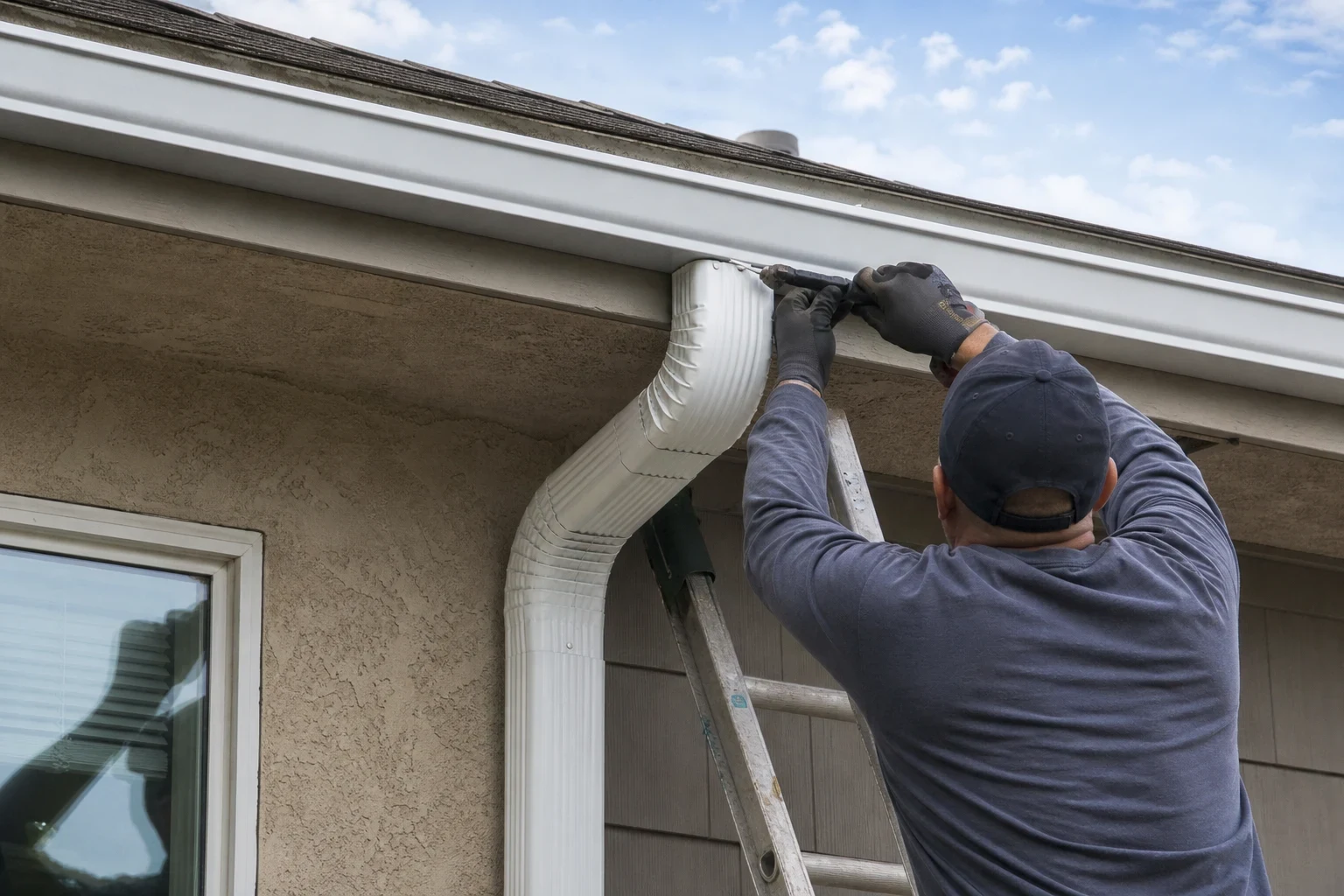
We install and repair one-piece aluminum gutters, downspouts and the fascia behind them. Each run is pitched toward its outlet, hung on hidden hangers and tied into the roof edge with drip edge, so water lands in the gutter and leaves through the downspout instead of running behind it.
What a Gutter System Actually Does for Your Home
A gutter is the last part of the roof's drainage path. Shingles or tile shed water to the eave, the drip edge kicks it past the fascia board, and the gutter collects it and sends it to a downspout that drops it away from the foundation. When any link fails, water runs down the siding, soaks the fascia and pools against the slab, the crawlspace vents or the planter beds along the wall.
Our rain tends to arrive in a short season, often a few heavy storms between November and March after months of dry weather. Gutters that sat full of leaves and dust all summer get tested all at once, and a sagging run or a loose downspout shows up as a stained eave or a washed-out bed.
We treat the gutters as part of the roof, not an add-on. If the drip edge is missing or the first course of shingles falls short of the edge, even a brand-new gutter will drip at the back, so we correct that during the same visit.
What Our Gutter Work Includes
- One-piece aluminum runs
- We roll-form K-style gutters on site from coil, cut to the exact length of each eave. The only joints are at corners and end caps, which means fewer sealed seams to dry out and drip.
- Right size, right pitch
- Most homes take a 5-inch gutter, but long eaves and tile or steep roofs that dump water fast often need 6-inch gutters with larger 3x4 downspouts. We set roughly a quarter inch of fall per ten feet toward each outlet so water drains instead of standing in the trough.
- Hidden hangers into solid wood
- Hangers go in about every two feet and are screwed through the fascia into the rafter tails. The spike-and-ferrule hardware on older installs works loose as the wood shrinks and swells; screws hold.
- Fascia and drip edge repair
- Soft or rotted fascia gets replaced before anything hangs on it. We add or correct the drip edge so runoff clears the board rather than wicking behind the gutter.
- Downspouts that discharge well away
- We place downspouts where they can carry water several feet from the foundation, using extensions, splash blocks or a connection to an existing drain line if your yard has one.
- Repairs to sound gutters
- If your system is worth keeping, we reseal corners and end caps, rehang sagging sections, replace crushed downspouts and clear clogs.
Signs Your Gutters Need Work
Water sheeting over the front lip
Overflow during a steady rain points to a clog, a run pitched the wrong way, or a gutter too small for the roof area feeding it.
Drips behind the gutter
Water falling between the gutter and the house usually means missing drip edge or a gutter that has pulled away from the fascia. Left alone, it rots the fascia and the rafter tails behind it.
Sagging or bowed sections
A dip in the line means hangers have let go. Standing water in that low spot adds weight every storm and pulls the run down further.
Rust, split seams and old patches
Many homes around Los Alamitos date from the 1950s and 1960s and still carry sectional steel gutters with a seam every ten feet. Once those seams rust through, caulk only buys a season.
Peeling paint or streaks on the fascia
Dark streaks and blistered paint on the fascia or soffit show where water has been escaping for a while.
Erosion or puddles at the downspout
A trench in the soil or water pooling against the wall means the downspout is dumping too close to the foundation.
How a Gutter Job Runs
- 1
Free inspection and written estimate
We check the drip edge, fascia, hangers, pitch and every downspout, and look at the roof edge above them. You get photos of what we found and a free written estimate that lists each run in linear feet.
- 2
Removal and fascia prep
We take down the old gutters, probe the fascia for soft wood and replace any rotted sections. New boards are primed and painted as agreed before hanging.
- 3
Forming and hanging
We snap a chalk line along each eave to set the fall, roll-form the gutter to length, then hang it on screwed hangers. Corners and end caps are sealed and the downspout outlets are cut in.
- 4
Downspouts and a water test
After the downspouts and extensions are on, we run a hose through each run to confirm it drains to the outlet with no drips at the seams or behind the gutter.
- 5
Cleanup
Old gutters are hauled away, and we sweep up metal trimmings and run a magnet over the beds and driveway for screws.
What Moves the Price of Gutters
Gutter pricing comes down mostly to length and to what the gutter has to hang on. Every run is measured and written up by footage, alongside any fascia boards and downspouts, so each part of the total traces back to a specific stretch of your roofline. Financing is available through Service Finance Company, subject to credit approval.
- Linear footage and height
- Total length drives material and labor. Second-story eaves take more ladder setup and time than single-story runs.
- Trough width and coil thickness
- A wider trough and bigger outlets simply use more aluminum, so stepping up from the standard profile to the larger one raises the material line, and thicker coil stock adds a bit more. Homes nearer the coast toward Seal Beach get salt air that corrodes galvanized steel quickly, which is one reason we recommend aluminum.
- Fascia condition
- Rotted fascia has to be replaced before a gutter can be hung. We probe it during the inspection so any board replacement is on the estimate, not a surprise.
- Corners, outlets and downspouts
- Each mitered corner, outlet and downspout adds parts and labor. Houses with many roof breaks need more of them.
- Roof edge corrections
- Adding drip edge, or working around tile that overhangs the eave, adds time but keeps water from getting behind the new gutter.
Gutter Questions We Hear
Something not covered here? (562) 374-8848
It barely rains here. Do I really need gutters?
Yes. Our rain often comes in a few heavy storms, and a roof sheds a lot of water in a short time. Without gutters, that water lands at the foundation, splashes mud onto the siding and soaks the fascia edge. The dry months just mean the problems show up all at once.
Can you repair my gutters instead of replacing them?
Often, yes. If the runs are aluminum and the fascia behind them is solid, resealing corners, rehanging sags and fixing downspouts is usually the better value. Rusted sectional steel or rotted fascia along most of the eave is where replacement starts to make more sense, and we will show you photos either way.
Can gutters go on a tile roof?
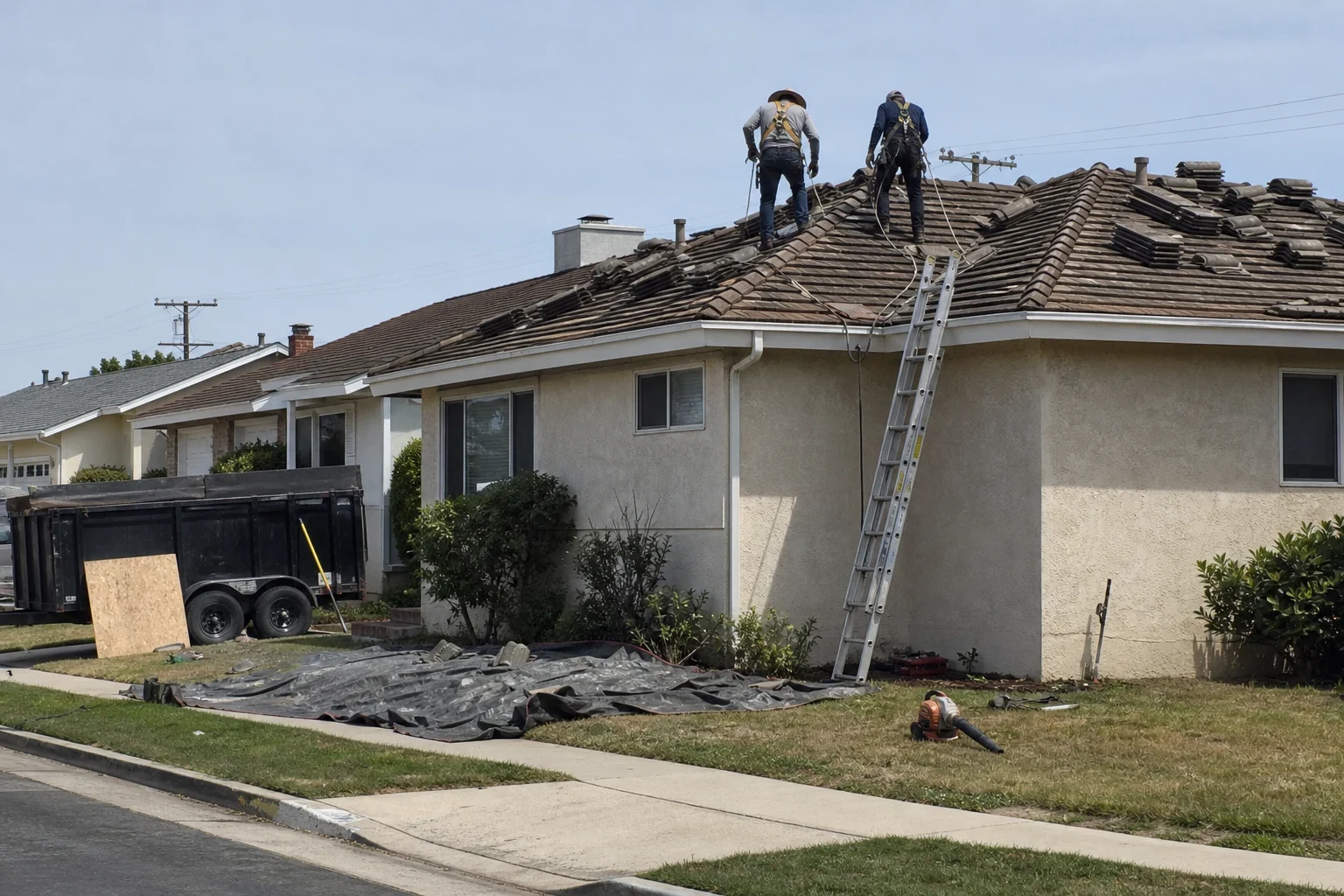
They can, but the tile overhang and the weight of water coming off it need planning. We set the gutter so the tile edge drains into it without the hangers lifting the tile, and often size up to 6-inch. Our Tile Roofing page covers the roof side of that work.
Should I replace my gutters when I replace my roof?
If your gutters are near the end of their life, yes. The drip edge comes off during a roof replacement anyway, so new gutters can be hung against new drip edge in one coordinated job instead of disturbing the roof edge twice.
How long does a gutter installation take?
A typical single-story home is usually finished in one day. Two-story homes, long fascia repairs or a lot of downspouts can stretch it longer, and we tell you the expected schedule when we give the estimate.
Does my homeowner's insurance cover gutter damage?
Sometimes, when wind or a falling limb caused it, and not when the cause is age or wear. We work directly with your insurance claim by documenting the damage with photos and measurements, while the adjuster decides what the policy covers.
Have Your Gutters Checked Before the Rain Season
We will look over your gutters, fascia and roof edge, photograph what we find and put a free written estimate in your hands. Service in English and Spanish.